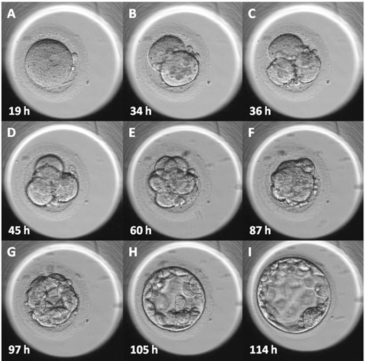
Retrieval day is a mix of emotion and anticipation. What happens next — inside the lab — is invisible to most patients, and that invisibility creates anxiety. Here is what actually occurs, day by day.
D0 — Retrieval day
Eggs are collected from each follicle a few hours after the trigger shot (the ovulation trigger). Eggs are not always retrieved — the more follicles, the better the chances of not coming up empty. And not all retrieved eggs are mature: on average, 70–80% are at the MII stage, ready for fertilization. Those that haven’t reached that maturity cannot be fertilized — that is not a lab error, it is biology.
The same day, fertilization is performed by ICSI (intracytoplasmic sperm injection): a single sperm is injected directly into each mature egg.
D1 — Fertilization check
Fertilization is assessed 16–18 hours later. Embryologists look for “2 pronuclei” (2PN): the sign that the sperm entered correctly, though the chromosomes have not yet merged. An embryo with 1 PN or 3 PN does not continue. This observation window and the normality criteria are part of the Istanbul Consensus, published in Human Reproduction in 2011 by Alpha Scientists in Reproductive Medicine and ESHRE, which established the reference benchmarks for IVF embryology laboratories.
Normal fertilization rate: 65–75% of mature eggs inseminated. If you had 8 mature eggs and 5 fertilized, that is within the expected range. Keep in mind these ranges are general — some cases fall above or below what’s expected.
D2 and D3 — Early cleavage
Fertilized embryos begin dividing. By day 2, you expect 2–4 cells; by day 3, 6–8 cells. A good-morphology D3 embryo has cells of similar size, minimal fragmentation, and an appropriate division rate. Embryos that divide too slowly or show excessive fragmentation have a lower chance of reaching blastocyst. That said, it is very difficult to predict which embryo will reach blastocyst at this stage. That is why patients often don’t receive detailed day-by-day updates — it can create false expectations or unnecessary frustration.
D4 — Morula
Embryos begin compacting: the cells fuse together and the embryo looks like a mulberry. Not all reach this stage — some stop between D3 and D4. This is normal and expected; not every fertilized embryo has the potential to continue.
D5 and D6 — Blastocyst
The final stage before transfer or vitrification. An estimated 40–60% of embryos reach this stage (though this varies). The embryo forms two differentiated structures: the inner cell mass (ICM, future baby) and the trophectoderm (future placenta). Good-quality blastocysts are vitrified or transferred; those that did not reach this stage do not continue. This is also the stage at which embryos are biopsied for PGT-A (preimplantation genetic testing).
Some embryos need until D6 to become a blastocyst. A D6 blastocyst has the same potential as a D5 blastocyst if morphology is comparable.
How many reach blastocyst? Real numbers
Starting with 10 retrieved eggs, a typical progression looks like this:
- 7–8 mature (MII)
- 5–6 correctly fertilized (2PN)
- 3–5 reach D3 with good morphology
- 2–4 reach blastocyst stage
- 1–3 have quality sufficient to vitrify or transfer
These numbers are not failures — they are normal biology. Attrition between D0 and D5 is a feature of the human species, not a sign of individual bad prognosis. A study by Cimadomo and colleagues published in Frontiers in Endocrinology (2018) showed that blastocyst formation rates from fertilized eggs vary with age: approximately 55% in women under 35, 45% between ages 35–37, 38% between 38–40, and 28% over 40. Age accounts for much of the variability seen between cycles.
Why wait for blastocyst?
Waiting until D5/D6 naturally selects embryos with higher potential. A Cochrane review I published in 2022, which analyzed randomized controlled trials, showed that blastocyst transfer produces higher live birth rates per transfer — approximately 47% versus 39% with Day 3 embryos — especially in good-prognosis patients. However, it is important to clarify that cumulative rates (including frozen embryos) may be similar between both strategies, and that a blastocyst-first policy leads to more cancelled transfers when few embryos are available, just as a Day 3 policy leads to more unnecessary transfers.
Attrition from D0 to D5–D6 is not a failure — it is the natural selection process that would have happened anyway, now visible.