Implantation is the most critical moment of an IVF cycle — and also the most mythologized. What follows separates the science from popular belief.
What is implantation, exactly?
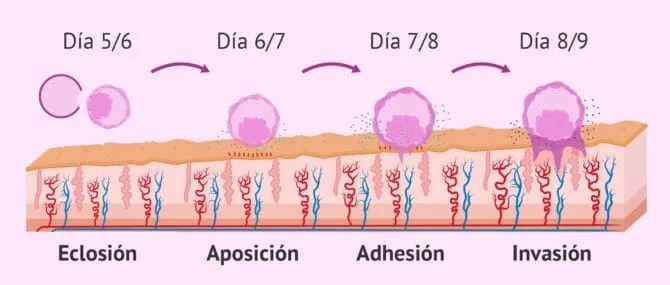
After transfer, the embryo needs to complete three steps: hatch from its zona pellucida (if it hasn’t already), make contact with the endometrium, and begin invading the superficial uterine lining. This process is not instantaneous — it takes between 6 and 10 days from fertilization.
When does it happen after a blastocyst transfer?
If you transfer a D5 blastocyst, the days following transfer unfold like this:
- Days 1–2: the embryo finishes expanding and hatching in the uterine cavity
- Days 3–4: the embryo makes contact with the endometrium (apposition)
- Days 4–5: firm adhesion to the endometrium
- Days 5–6: trophoblastic invasion begins
- Days 9–11: hCG rises enough to be detectable in blood
A positive beta at 9–11 days post blastocyst transfer is a sign of successful implantation. Testing before that window can give a false negative — or a false positive if trigger hCG is still circulating. This timing is biologically consistent with what we know from natural conception: a landmark study by Wilcox, Baird and Weinberg published in the New England Journal of Medicine (1999) documented that implantation occurs between Days 6–10 post-ovulation in natural cycles, and that late implantations — Day 10 or later — are associated with pregnancy loss rates above 82%.
The implantation window
The endometrium is not receptive all the time. The implantation window — the period when the endometrium will accept an embryo — lasts approximately 24–48 hours, though this varies between women. In most normal cycles this window is synchronized with the embryo’s stage. The endometrial receptivity test (ERA or others) attempts to personalize it in cases of repeated failure, though its clinical utility is still being evaluated.
The myths I hear most often
“I can’t bend over or make any sudden movements after transfer.” False. The embryo doesn’t “fall out.” The uterus is a virtual cavity — the embryo is between its walls, not floating. Normal movements do not affect implantation.
“Complete bed rest increases the chances.” The evidence says otherwise. A randomized controlled trial by Lambers and colleagues published in Human Reproduction (2009) found no difference between absolute bed rest and immediate mobilization after transfer: clinical pregnancy rates were 27.1% versus 28.4% respectively (p=0.92). A systematic review by Abou-Setta and colleagues in Fertility and Sterility (2007) reached the same conclusion: odds ratio of 1.00 (95% CI 0.74–1.35), with no detectable benefit from rest. Normal activity after transfer is completely safe.
“Eating pineapple after transfer helps implantation.” No study supports this. Bromelain — the enzyme in pineapple — does not reach the uterus in relevant amounts through oral consumption.
“If I feel cramps, the embryo implanted.” Post-transfer cramping is common and has many causes: cervical mucus, the catheter, uterine distension from transfer media, progesterone. Cramps are not diagnostic of implantation.
What actually matters for implantation
Factors with genuine evidence behind them:
- Embryo quality: by far the most determinant factor (most variables that determine embryo quality are unknown to us; normal chromosomes are an important part of it)
- Adequate endometrium: there is no defined minimum thickness (some say 6–7 mm), trilaminar pattern on ultrasound
- Progesterone support in the luteal phase: essential in frozen embryo transfer cycles
- Absence of uterine pathology: submucosal fibroids, polyps, adhesions
The role of progesterone
In frozen embryo transfer cycles, exogenous progesterone supports the endometrium until the placenta takes over (around weeks 10–12). It is critical not to stop it prematurely — but equally important not to continue taking it without medical guidance if the beta is negative. Natural cycle protocols are increasingly used today, relying on endogenous progesterone produced by the corpus luteum — along with other molecules it releases — to support implantation.
Implantation cannot be forced with bed rest, diet, or rituals. It can be optimized with embryo quality, a good lab, and a well-prepared endometrium.