
Your body is working hard during these days. Knowing what to expect helps you get through them with more calm.
Ovarian stimulation is often the first time treatment becomes physically real. Until now, everything was consultations, blood tests, and ultrasounds. Daily injections change that. The process takes on a new presence in daily life.
This guide covers what happens in your body during stimulation, what symptoms deserve attention, and what you can let go.
Daily injections
The injections contain FSH hormones — such as Gonal-F, Puregon, or Rekovelle — with or without LH activity (Menopur, Pergoveris). They tell the ovaries to mature several follicles at once. In a natural cycle, only one follicle matures per month. During stimulation, the goal is more. How many depends on your individual response.
You inject the dose subcutaneously, usually in the abdomen. The team adjusts doses at each monitoring visit based on how your ovaries respond. There is no fixed protocol — it is personalized and calibrated in real time.
Consistency in timing matters most. Stable hormone levels in the blood require regular injection times. A margin of one hour either way is fine. If you need to shift the time one day, let your medical team know.
What you will feel physically
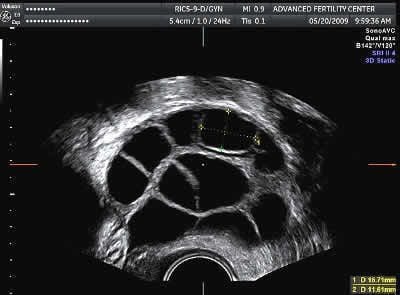
As follicles grow, the ovaries enlarge — from a normal 3–5 cc to 20–30 cc or more by the end of stimulation. You will notice that increase: abdominal bloating, pelvic heaviness or pressure, and sometimes something resembling a sustained premenstrual discomfort.
Mood swings are also common. Estrogen levels during a stimulated cycle can run 5 to 10 times above normal. That has a real emotional impact. It is not exaggeration, not weakness — it is biochemistry.
These discomforts usually ease within hours after the retrieval. The more follicles you develop, the more bloating to expect, and the longer it may take to settle. It rarely lasts more than 3–4 days post-retrieval.
Ultrasound monitoring
Expect 3 to 5 ultrasound checkups during stimulation, usually on alternating days toward the end of the cycle. At each visit, the doctor measures follicle diameter. When several reach 18–20 mm, that signals maturity and the team schedules the retrieval. Your specific response may shift that timing earlier or later.
Blood tests check estradiol and sometimes progesterone and LH. These values complement the ultrasound to set the timing of the trigger shot — the injection that triggers final egg maturation. The trigger is usually hCG, a GnRH agonist, or both.
Your doctor specifies an exact time for the trigger shot. The retrieval follows 34 to 36 hours later. That window is critical: too early means immature eggs; too late risks ovulation before retrieval.
Limit physical activity during stimulation. Ask your team about which intensity levels to avoid and when to stop. Enlarged ovaries sit in a position more prone to twisting. Sudden movements raise the risk of ovarian torsion — a surgical emergency that causes severe pain. Reducing that risk is simple: move gently.
