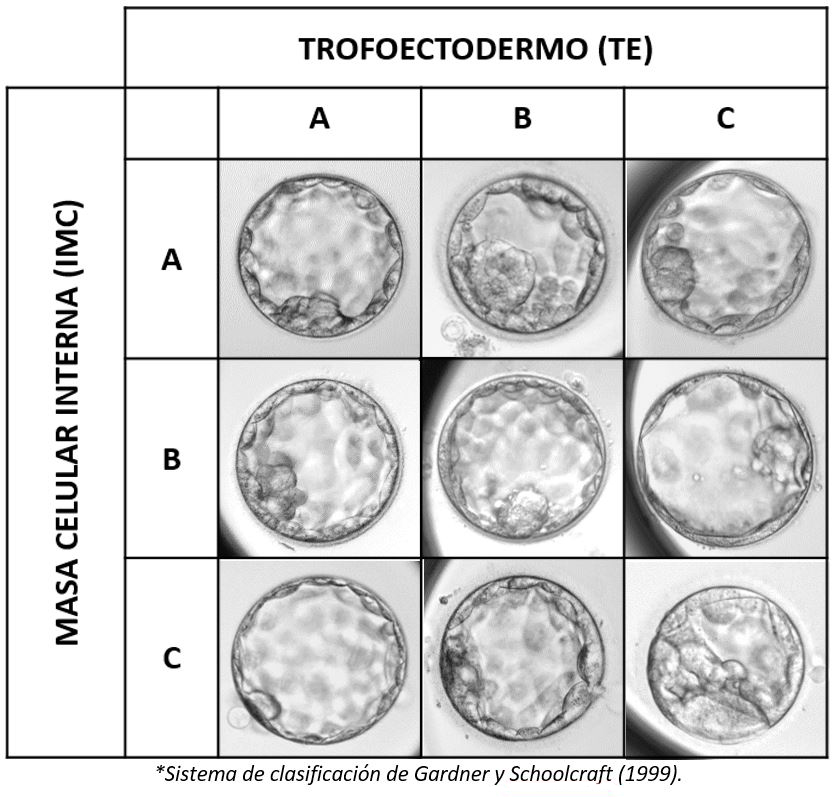
A friend tells you to ask about embryo quality. Your doctor may explain that so-called embryo quality doesn’t predict outcomes very well — but gives you the grade anyway. A message arrives: “You have one 4AA blastocyst and two 3BBs.” Without context, this means nothing. With context, it doesn’t say much — though it does say a little.
The Gardner system: three components
The Gardner grading system evaluates blastocysts across three independent dimensions: expansion, inner cell mass, and trophectoderm.
1. Expansion (number 1–6)
- 1: Early blastocyst, small cavity (<50% of volume)
- 2: Blastocyst, cavity <50% of total volume
- 3: Full blastocyst, cavity fills the embryo
- 4: Expanded blastocyst, zona pellucida thinning
- 5: Hatching blastocyst (part of embryo escaping zona)
- 6: Hatched blastocyst (completely outside zona)
Greater expansion generally means greater maturity and better prognosis. Grades 4, 5, and 6 are most commonly selected for transfer.
2. Inner cell mass / ICM (first letter)
The ICM is the cell cluster that will become the fetus.
- A: Many cells, tightly packed and well-cohesive
- B: Several cells, less compact
- C: Few cells, poorly cohesive
3. Trophectoderm (second letter)
The trophectoderm will form the placenta.
- A: Many cells forming a cohesive layer
- B: Few cells forming a discrete layer
- C: Very few large or loose cells
What does morphology predict?
The Gardner grading system was first described by Gardner and Schoolcraft in 1999, with data showing implantation rates of around 65% for top-grade AA blastocysts. Later research confirmed and refined those findings. A study by Ahlström and colleagues published in Human Reproduction (2011) identified trophectoderm quality as the single most important predictor of live birth among the three Gardner components: TE-A achieved a live birth rate of 48%, TE-B 36%, and TE-C 19%. Even so, grades should not be given more weight than they deserve — they are not a reason to get your hopes up or feel discouraged prematurely, nor a basis for conclusions after a negative result.
What Gardner grading does not measure
Morphology predicts some degree of probability, not certainty. A 4AA embryo can fail to implant; a 3BB can become a perfectly healthy baby. The Gardner system is a visual assessment — it does not detect chromosomal abnormalities. That is what PGT-A does, by analyzing the embryo’s genetic makeup.
Two different systems answering two different questions. Gardner: does the embryo look good? PGT-A: does the embryo have the right chromosomes?
Importantly, morphology does not become irrelevant once chromosomal status is known. A study by Irani and colleagues in Fertility and Sterility (2017) found that among PGT-A euploid blastocysts — all with confirmed normal chromosomes — top-grade embryos achieved approximately 67% live birth while low-grade euploids reached only around 49%. Morphology and chromosomal status are complementary layers of information, not substitutes for each other. That said, labeling an embryo as “high quality” or “low quality” based on morphology alone can sometimes backfire, leading to incorrect conclusions.
Day of development is another factor the Gardner classification doesn’t capture. An analysis by Cimadomo and colleagues in Human Reproduction Update (2023) found that Day 5 blastocysts achieve approximately 10–15 percentage points higher live birth rates than Day 6 blastocysts of the same morphological grade. A good-quality D6 embryo is still worth transferring — but understanding that day of development matters before drawing conclusions from your results is important. It’s also worth noting that each lab has different outcomes, so understanding the impact of these variables in your specific lab becomes relevant before making any judgments.
A note on lab variability
The Gardner system is standardized, but its application varies between labs. A 4BB at one center may be a 3BB at another. What matters more than the exact grade is the lab’s overall blastocyst rate and its historical live birth rates by embryo quality.
Morphology is a map, not the territory. A 3BB with normal chromosomes has a better prognosis than a 4AA with chromosomal abnormalities — logically.