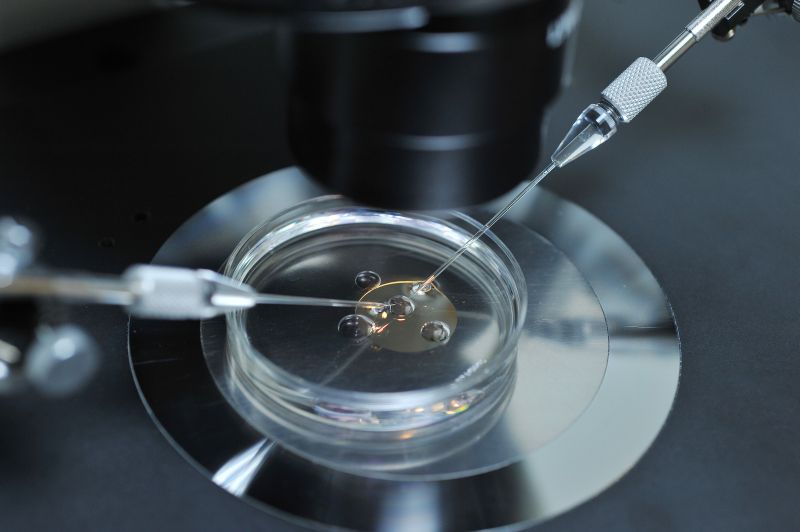
When doctors talk about “fertilization rates” and “embryo attrition,” they are describing the normal natural selection process that occurs in the lab. Understanding these numbers reduces anxiety and helps patients make better decisions.
What is a normal fertilization rate?
After ICSI, expected rates are:
- 65–75% of mature eggs (MII) → 2PN (correctly fertilized)
- <10% polyspermia (more than 2 pronuclei) → these do not continue
- ~15–20% degenerate or do not fertilize → also normal
If 8 mature eggs produced 5 correctly fertilized embryos, that is within the expected range. A 0% fertilization rate with ICSI is the number that warrants evaluation — not 5 out of 8. These benchmarks were codified in a consensus statement by Racowsky and colleagues published in Fertility and Sterility (2010) on behalf of SART and ASRM, which established an expected 2PN rate post-ICSI of 65–80% of MII oocytes as the standard reference range for laboratory performance.
What is embryo attrition?
Of every 100 embryos that fertilize (2PN), you can roughly expect:
- 50–65 reach morula stage (D4)
- 40–55 reach blastocyst (D5/D6)
- 30–45 have good morphology to vitrify or transfer
- 85–95% of vitrified embryos survive the warming process
This is not a lab failure or your failure. It is the selection process that would occur in the body anyway — you can just see it now. Research by Baart and colleagues published in Human Reproduction (2006) found that 60–70% of Day 3 embryos from stimulated cycles carry chromosomal errors; the majority of those naturally arrest before reaching blastocyst, which is exactly what should happen.
The “almost made it” experience
Many patients ask: why did my embryo reach D3 but not D5? Because the transition to blastocyst requires the embryonic genome to “switch on” — the so-called embryonic genome activation. If the embryo has chromosomal abnormalities, this process frequently fails and development stops. Natural selection working correctly.
An embryo that didn’t reach blastocyst was not “lost” by the lab. It was naturally selected out for lacking the potential to continue.
How attrition changes with age
Embryo attrition increases with maternal age because chromosomal abnormality rates in eggs increase with age:
- At age 30: ~20–25% of eggs have chromosomal abnormalities
- At age 38: ~50% of eggs have chromosomal abnormalities
- At age 42: ~80% of eggs have chromosomal abnormalities
This explains why 10 eggs at age 30 might yield 4 good-quality blastocysts, while 10 eggs at age 42 might yield 1 or none. The age-stratified data from Cimadomo et al. published in Frontiers in Endocrinology (2018) quantified this directly: blastocyst development rates fall from roughly 55% under age 35 to approximately 28% over age 40 — a gradient that reflects egg chromosomal quality, not laboratory performance.
Numbers that do warrant discussion
Some outcomes fall outside expected ranges and deserve analysis:
- 0% fertilization rate with ICSI
- No embryos reaching D3
- Fertilization rate <40% across repeated cycles
- Blastocyst rate <20% with a good fertilization rate
In those cases, the lab and physician will evaluate possible contributing factors: sperm quality, oocyte quality, culture conditions.
Three blastocysts from 10 retrieved eggs is a completely normal result. Don’t chase numerical perfection; look for a lab that reliably reaches that stage.