
A frequently asked question is the following: is there any real difference between one IVF clinic and another one? Although there is not a simple answer because that question covers many domains, I will try to go through this topic.
Two IVF clinics could be different in many items: the personalized (or not) attention that doctors give to their patients; the follow-up and fluid communication (or not) that doctors establish with their patients; the length of time that doctors dedicate at each consultation; the quality of the evidence that supports every explanation that is given by the doctors (or, conversely, if they are based only on “our best experience”).
Two programs could be different because doctors could offer a shared decision-making process (democratizing the available medical information) or just making decisions unilaterally. They could be different in the way that physicians introduce the available alternatives, being more or less didactic to explain the probabilities of success of each of them, and the advantages and disadvantages. Some could also consider (or not) the values and preferences of each patient, or they could just consider technical aspects or values that only concern the physician.
We could also find these differences among doctors that attend at the same clinic. Sometimes these differences are more pronounced and, in other cases, the doctors are more aligned. However, medical training, teaching resources, personal experience, and decision aid tools, coupled with the empathy and personality of the physician, make a better or worse experience and could be very different between the centers and/or between doctors.
There are centers that produce normal embryos more often than others
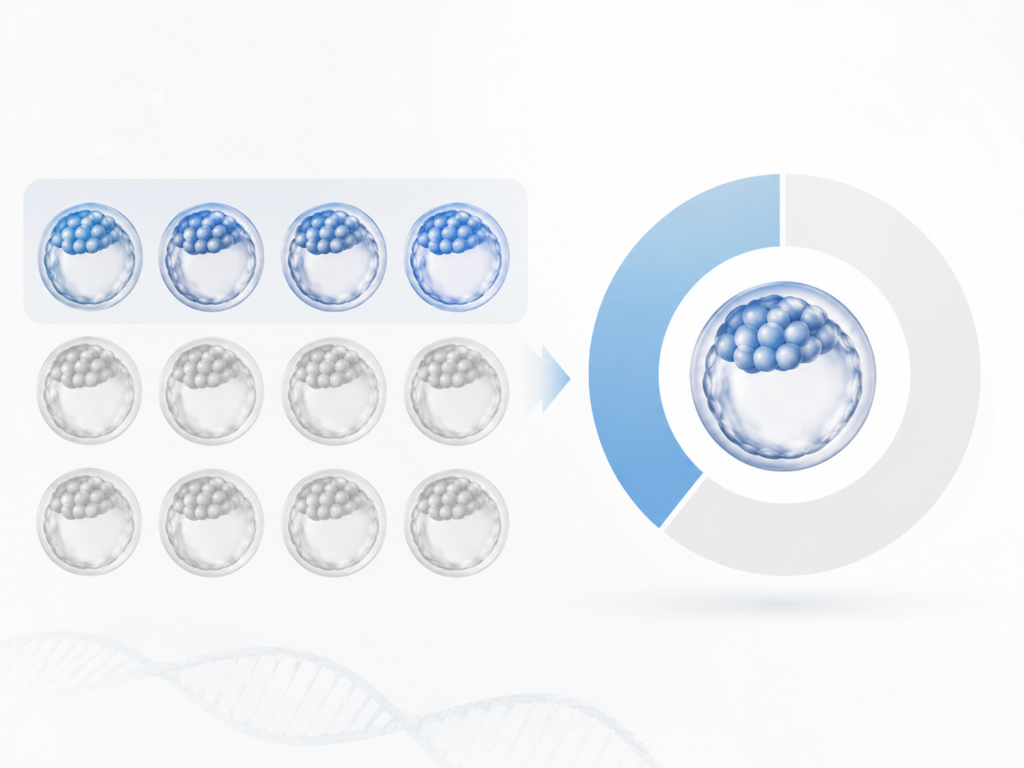
In April 2017, Munne et al. published a study in Human Reproduction where they evaluated the biopsies of 13,595 embryos from 1,665 donors who were analyzed with PGS from 42 US centers and 126 different doctors. This study had the strength of having evaluated only donors, reducing some variability that could be found in patients that use own eggs. It was interesting to observe that the proportion of euploid embryos (i.e., chromosomally normal embryos) was very different among the fertility centers, finding 68.5% of euploid embryos per donor on average, but in a range from slightly below 40% to some above 80%. In other words, from the chromosomal point of view, there were centers in which only 4 out of 10 embryos were normal whereas there were centers where the proportion of chromosomally normal embryos was greater than 8 out of 10.
The embryology laboratory and the doctor
In egg donation, some might think that there should not be large differences between one clinic and another. Why? Because if the only difference in results was the variability among patients, then in egg donation that problem should not exist. However, differences in success rates among different egg donor programs are very large.
Why do some clinics have better results?
Are the doctors important? They are. They participate in a large part of the process, taking care of everything mentioned above, plus the decision on how to perform ovarian stimulation, day-to-day decisions throughout the ovarian stimulation, and the decision of using any complementary strategies (and, of course, the technique of the embryo transfer).
Well, all of these aspects could, potentially, impact on oocyte quality and, therefore, on embryonic quality.
The embryology laboratory and its infrastructure are also critical in the final statistics. The embryo lab plays an essential role in the few days from fertilization until the embryos are transferred. Variables such as the fertilization technique, the culture media, the incubators, the temperature and the gases used, the filters that preserve the environment from any contamination — each of these issues could potentially cause gametes and embryos to develop differently and thus have a higher or lower proportion of normal embryos.
We know that, objectively, we want to have euploid embryos (chromosomally normal). And although previously we could have speculated that the proportion of normal chromosomally embryos could change as a function of all these variables, now we know it is not a speculation any more. It occurs. We may not know which variable(s) are most influential, but we know that many of them are very important.
In summary: choosing well is important
We have found objective data that may explain why some egg donor programs (and, of course, IVF clinics in general) have higher pregnancy and live-birth rates than others: the proportion of euploid embryos (chromosomally normal) is higher in some centers than in others. In conclusion, choosing the right doctor and fertility center is very important.
“In the same study, the proportion of chromosomally normal embryos ranged from below 40% to above 80% across different clinics — using the same donors. Choosing the right center genuinely matters.”
